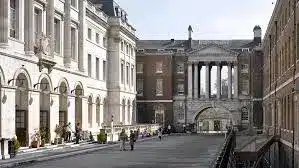

De Montfort University Leicester
Rich historical setting of the campus and surroundings
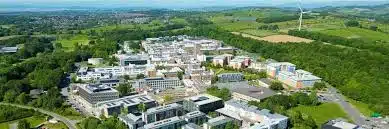
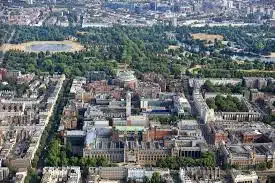
De Montfort University’s Leicester campus is situated in an area renowned for its deep historical significance. Archaeological evidence, including an Iron Age ditch and pottery, shows that the area was once a suburb of the main Roman settlement, located just south of the city walls.
About De Montfort University Leicester
In 1239, Simon de Montfort became Earl of Leicester and ruled from Leicester Castle, positioned just north of what is now the Trinity Building. Simon de Montfort is celebrated for summoning the first representative “House of Commons” in 1265, an event described by Winston Churchill as having “lighted a fire never to be quenched in English history.”
De Montfort University Leicester – Table of Contents
- About
- Courses Offered
- Other Courses
- Facilities And Infrastructure
- Required Documents
- Intake
- Eligibility Criteria
- Admission Process
Becoming De Montfort University
Leicester Polytechnic officially became De Montfort University on 26 June 1992, taking its name from Simon de Montfort to reflect its historic ties to the city. During the 1990s, DMU expanded into a distributed campus model with sites in Leicester, Milton Keynes, Lincoln, and Bedford, enrolling more than 30,000 students at its peak. Notable developments included the opening of the environmentally innovative Queen’s Building in 1993 and the formation of the Charles Frears campus in 1995 following a merger with a nursing and midwifery college.

Trinity Hospital and the Church of the Annunciation
In 1330, Henry, 3rd Earl of Leicester and Lancaster, commissioned an almshouse and hospital to care for the poor and infirm of the city on land bordering the castle precinct. Originally named the Hospital of the Honour of God and the Glorious Virgin and All Saints, it later became known as Trinity Hospital in 1614. Although the building was reconstructed in 1776 and again in 1901, the original medieval chapel remains visible in Trinity House today.
Henry’s son continued this legacy by expanding the hospital and founding the Church of the Annunciation of the Blessed Virgin Mary, which once stood on the site now occupied by the Hawthorn Building. This development became known as the Newarke, derived from the term “new work.”
The church served as a chantry, where priests prayed for the souls of the House of Lancaster, and housed a revered relic—a thorn from the Crown of Thorns—gifted by the King of France. Although no drawings of the church survive, historical accounts describe it as an exceptionally beautiful structure. Some chronicles also suggest that the body of King Richard III was displayed there in 1485 to confirm his death. The church was demolished in 1548 during the Reformation, after which the area evolved into a residential neighborhood.
In the nineteenth century, the Industrial Revolution transformed Newarke dramatically. Orchards and gardens gave way to factories and workshops. Several present-day DMU buildings reflect this industrial heritage: the Clephan Building was formerly a hosiery factory, the Campus Centre occupies the site of a worsted mill, and the Portland Building once functioned as a shoe factory. The Fletcher Building and Kimberlin Library were built on land previously occupied by rows of terraced housing.
Archaeology and preservation on campus
The Leicester Municipal Technical and Art School was established in the Newarke when the first wing of the Hawthorn Building was constructed on the former gardens of a house built over the remains of the Church of the Annunciation. During redevelopment in 1937, two medieval arches from the church were discovered embedded in a cellar wall, along with bones, a coffin, and architectural fragments. These arches were preserved and later incorporated into the Hawthorn Building, where they remain visible today.
In the 1990s, DMU further strengthened its connection to local history by acquiring Trinity Hospital buildings and the Portland Shoe Factory, which included the Chantry Building. Built around 1350 as accommodation for a church canon, the Chantry later served as a vicarage and then a leather store. Structural instability led to the removal of its upper storeys, giving the building its distinctive appearance.
Origins and early development of De Montfort University
De Montfort University Leicester is a modern institution shaped by a long tradition of educational innovation. Its origins date back to 1870 with the founding of the Leicester School of Art, established to provide professional art instruction to the people of Leicester.
Around the same time, technical classes led by Reverend James Went grew rapidly, resulting in the creation of the Leicester Technical School in 1882. In 1897, these institutions merged to form the Leicester Municipal Technical and Art School, leading to the construction of the Hawthorn Building in Newarke.
Growth through war and vocational education
During World War I, the institution supported the war effort by establishing munitions workshops and retraining injured servicemen. Many staff and students served in the armed forces, with at least 20 losing their lives. In 1929, the school was reorganised into the Leicester College of Arts and Crafts and the Leicester College of Technology, offering vocational programmes in architecture, engineering, textiles, footwear, pharmacy, and design.
World War II again disrupted academic life, with buildings fortified and staff and students contributing to wartime production and civil defence. After the war, it was revealed that the campus had secretly operated as a radar training centre.
The polytechnic era
In 1969, the institution became the City of Leicester Polytechnic, marking a period of rapid expansion. New buildings were added, including the Fletcher Building and the James Went Building, and former industrial structures were repurposed for academic use. Mergers with other educational institutions broadened the curriculum to include teacher training, performing arts, social studies, and healthcare disciplines.
Latest Notifications:
Courses Offered and Duration & Cost of Study in De Montfort University Leicester
Cyber Security
Course Details
Study Mode: Full Time
- Duration: 1 year full time, tuition fee: 18,600 GBP, Course starts in January and September.
Entry Requirements
- Applicants must hold an undergraduate degree at 2:2 level or above (or equivalent) in a relevant subject.
- Relevant subjects include, but are not limited to:
- Computer Science, Computer Security, Informatics, Electrical and Communication Engineering, Cyber Security, Software Engineering
- If English is not the applicant’s first language, an IELTS score of 6.0 overall, with no less than 5.5 in each band (or an equivalent English language qualification), is required at the start of the course.
Mechanical Engineering
Course Details
Study Mode: full-time
- Duration: 1 year full time, tuition fee: 18,600 GBP, Course starts in September and January.
Entry Requirements
- Applicants should hold the equivalent of a British Honours degree with a minimum classification of 2:2 in a relevant subject.
- Equivalent qualifications from any country worldwide are accepted and considered.
- Applicants without formal academic qualifications but with substantial and relevant industry experience may also be considered on an individual (case-by-case) basis.
- If English is not the applicant’s first language, an IELTS score of 6.0 overall, with a minimum of 5.5 in each band (or an equivalent English language qualification), is required at the start of the course.
Artificial Intelligence
Course Details
Study Mode: full-time
- Duration: 1 year full time, tuition fee: 18,600 GBP, Course starts in September and January.
Entry Requirements
- Applicants should hold the equivalent of a British Honours degree with a minimum classification of 2:2 in a relevant subject.
- Equivalent academic qualifications from any country worldwide are accepted and will be considered.
- If English is not the applicant’s first language, an IELTS score of 6.0 overall, with at least 5.5 in each band (or an equivalent English language qualification), is required at the start of the course.
Electronic Engineering
Course Details
Study Mode: Full Time
- Duration: 12 Months full time, tuition fee: 18,600 GBP, Course starts in September and January.
Entry Requirements
- Applicants should have the equivalent of a British Honours degree with a minimum of 2:2 in a relevant subject.
- Equivalent qualifications from universities worldwide are accepted and will be considered.
- If English is not the applicant’s first language, an IELTS score of 6.0 overall, with a minimum of 5.5 in each band (or an equivalent English language qualification), is required at the start of the course.
Software Engineering
Course Details
Study Mode: Full Time
- Duration: 12 Months full time, tuition fee: 18,600 GBP, Course starts in September and January.
Entry Requirements
- Applicants should hold the equivalent of a British Honours degree with a minimum classification of 2:2 in a relevant subject.
- Equivalent qualifications from recognized institutions worldwide are accepted and will be considered.
- If English is not the applicant’s first language, an IELTS score of 6.0 overall, with at least 5.5 in each band (or an equivalent English language qualification), is required at the start of the course.
Data Analytics
Course Details
Study Mode: full-time
- Duration: 12 Months full time, tuition fee: 18,600 GBP, Course starts in September and January.
Entry Requirements
- Equivalent of a British Honours degree with a minimum classification of 2:2 in a relevant subject.
- Equivalent academic qualifications from recognised institutions worldwide are accepted.
- If English is not the first language, an IELTS score of 6.0 overall, with at least 5.5 in each band (or an equivalent English language qualification), is required at the start of the course.
Master of Business Administration MBA
Course Details
Study Mode: Full Time
- Duration: 12 Months full time, tuition fee: 20,900 GBP, Course starts in September.
- Duration: 18 Months full time, tuition fee: 20,900 GBP, Course starts in January.
Entry Requirements
- An undergraduate degree in any subject with a minimum classification of 2:2, or an equivalent overseas qualification.
- Alternatively, a minimum of five years of relevant managerial work experience, or an equivalent level of professional experience, may be accepted.
- Professional qualifications deemed to be of equivalent standing are considered on an individual (case-by-case) basis.
- If English is not the applicant’s first language, an IELTS score of 6.0 overall, with at least 5.5 in each band (or an equivalent English language qualification), is required at the start of the course.
Human Resource Management MA
Course Details
Study Mode: full-time
- Duration: 1 year full time, tuition fee: 19,000 GBP, Course starts in September.
Entry Requirements
- An undergraduate degree in any subject with a minimum classification of 2:2, or an equivalent overseas qualification.
- An equivalent professional qualification may also be considered.
- If English is not the applicant’s first language, an IELTS score of 6.0 overall, with at least 5.5 in each band (or an equivalent English language qualification), is required at the start of the course.
Doctor of Business Administration DBA
Course Details
Study Mode: Full Time
- Duration: 3 years full time, Course starts in January.
- Duration: 18 Months full time, Course starts in April.
Entry Requirements
- An honours undergraduate degree with a minimum classification of 2:1.
- Membership of a recognized (chartered) professional body may be accepted as an alternative qualification.
- Equivalent professional qualifications or relevant managerial/directorial experience may also be considered.
- A substantial record of supervisory and/or managerial responsibilities, held on a permanent or periodic basis, is required; for indicative purposes, this is typically equivalent to around five years of experience.
- Submission of a detailed research proposal is required.
- A current curriculum vitae (CV) must be provided.
- If English is not the first language, an IELTS score of 6.5 overall, with a minimum of 6.0 in each component (or an equivalent English language qualification), is normally required.
- English language tuition is available at De Montfort University both before and during the course, if required.
Marketing Management
Course Details
Study Mode: full-time
- Duration: 16 Months full time, tuition fee: 19,000 GBP, Course starts in September and January.
Entry Requirements
- An undergraduate degree in any subject with a minimum classification of 2:2, or an equivalent overseas qualification.
- No previous experience in marketing is required.
- Applicants without formal academic qualifications but with significant business experience may be considered on an individual (case-by-case) basis.
- If English is not the first language, an IELTS score of 6.0 overall, with at least 5.5 in each band (or an equivalent English language qualification), is required at the start of the course.
Engineering Management
Course Details
Study Mode: Full Time
- Duration: 12 Months full time, tuition fee: 18,600 GBP, Course starts in September and January.
Entry Requirements
- Equivalent of a British Honours degree with a minimum classification of 2:2 in an engineering-related subject.
- Applications from mature students and holders of equivalent international qualifications are accepted.
- Applicants with academic qualifications below the standard entry criteria can be considered if they have significant relevant work experience.
- If English is not the first language, an IELTS score of 6.0 overall, with at least 5.5 in each band (or an equivalent English language qualification), is required at the start of the course.
Interior Design
Course Details
Study Mode: Full Time
- Duration: 1 year full time, tuition fee: 16,800 GBP, Course starts in September and January.
Entry Requirements
- Equivalent or higher of a 2:2 UK bachelor’s honours degree in Interior Design or a related subject.
- Other professional qualifications and industry experience cn be considered on an individual (case-by-case) basis.
- Submission of a digital portfolio of work is required (refer to Interior Design application portfolio guidelines for details).
- Non-standard applicants can be invited to attend an online interview with a portfolio review.
- If English is not the first language, an IELTS score of 6.0 overall, with at least 5.5 in each band (or an equivalent English language qualification), is required at the start of the course.
List of Other Courses in De Montfort University Leicester
- Architecture Professional Experience
- Health Psychology
- Education Practice
- Mechatronics and Robotics
- Finance and Banking
- Accounting and Finance
- International Business Management
- Advanced Clinical Practice
- Aeronautical Engineering
- Advanced Biomedical Science
- Fashion Management with Marketing
- Visual Effects and Virtual Production
- Masters of Public Health
- Digital Forensics
Latest Updates:
Facilities And Infrastructure For De Montfort University, Leicester
Modern Campus Infrastructure
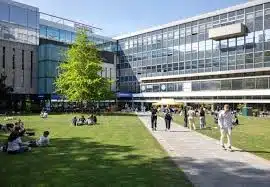
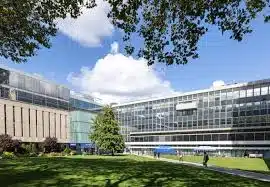
- A well-integrated urban campus located close to Leicester city centre
- Mix of historic buildings and contemporary, purpose-built facilities
- Sustainable and award-winning buildings, including the environmentally innovative Queen’s Building
Advanced Teaching & Learning Technologies
- Digitally enabled classrooms and lecture theatres
- Smart learning spaces with audio-visual systems and hybrid teaching facilities
- Virtual Learning Environment (VLE) for online resources, lectures, and assessments
Library & Learning Resources
- Kimberlin Library, open 24/7 during term time
- Extensive collection of print books, e-books, journals, and research databases
- Dedicated silent study areas, group study rooms, and IT workstations
- Academic skills support, including writing, research, and digital literacy assistance
Laboratories & Specialist Facilities
- State-of-the-art science and engineering laboratories
- Specialist labs for computing, cybersecurity, artificial intelligence, fashion, design, and health sciences
- Media studios, workshops, and creative production spaces
- Industry-standard equipment supporting practical and research-based learning
Student Accommodation & Hostels
- University-managed halls of residence close to campus
- Options include ensuite and shared accommodation
- Secure, fully furnished rooms with Wi-Fi and communal facilities
- Affordable accommodation options suitable for international students
Food & Catering Facilities
- On-campus cafeterias, food courts, and coffee shops
- Wide variety of cuisines, including vegetarian and international options
- Halal and vegan food choices available
- Student-friendly pricing
Sports & Fitness Facilities
- DMU Active gym with modern fitness equipment
- Sports halls and studios for indoor activities
- Outdoor sports facilities and nearby sports grounds
- Wide range of sports clubs and fitness programmes
Extracurricular (EC) Activities & Student Life
- DMU Students’ Union with over 150 student-led societies and clubs
- Cultural, academic, professional, and recreational societies
- Leadership, volunteering, and employability programmes
- Regular campus events, festivals, and workshops
Health, Wellbeing & Support Services
- On-campus health and wellbeing services
- Counselling and mental health support
- Disability and accessibility services
- International student support and visa guidance
Career & Employability Facilities
- Careers and Employability Service offering guidance, internships, and placements
- Dedicated enterprise and innovation hubs
- Strong industry links and placement opportunities
Safety & Campus Services
- 24/7 campus security and CCTV surveillance
- Student help zones and welfare support
- Safe and inclusive campus environment
Required Documents For Admission in De Montfort University Leicester
- Completed Application Form
- Filled through the DMU Online Portal or via email/DMUHub (for current DMU students).
- Academic Transcripts
- Copies of transcripts from all previous degrees (undergraduate).
- Degree/Diploma Certificates
- Copies of a bachelor’s degree certificate or equivalent qualification.
- Personal Statement (SOP)
- Usually about ~500 words explaining academic goals, motivation, and fit for the programme.
- References
- One or two academic or professional references on official letterheaded paper (signed & recently dated).
- Proof of English Language Proficiency
- E.g., IELTS or equivalent test scores (as specified for a course).
- Copy of Passport
- For international applicants to confirm identity and nationality.
- Additional Course-Specific Requirements (if applicable):
- Portfolio – for creative/design programmes.
- Supplementary Forms – some courses require extra forms related to the programme.
International Applicants
- Ensure English language test results meet the required level for the course (courses vary).
- Some applicants may also need to submit financial evidence and further documents after receiving an offer for CAS (Confirmation of Acceptance for Studies) – details provided in an offer letter.
Research Master’s / Masters by Research
If applying for a research-based master’s (like MRes):
- Students usually also need to submit a research proposal along with the standard documents.
Official site For De Montfort University Leicester: Click Here
Intake For De Montfort University Leicester
September Intake
- This is the main and largest intake of the academic year.
- Most Master’s programmes are available to start in September each year.
January/February Intake
- Many taught postgraduate courses also offer a January or February start, especially popular programmes in business, computing, and engineering.
April/May Intake (Select Courses)
- Some programmes may also have additional starts in April or May; however, this varies by course and isn’t as widely available as the September and January intakes.
Eligibility Criteria For Admission in De Montfort University Leicester
Bachelor’s Degree Requirement
- Applicants must have a bachelor’s degree from a recognised university. For most Master’s courses, a UK honours degree or an equivalent overseas qualification is required.
1. Minimum Degree Classification
- For courses requiring a UK 2:1 (Upper Second Class):
Equivalent to around 75%+ overall in many international bachelor’s degree systems or a GPA of approx. 3.0–4.0 (depending on country). - For courses requiring a UK 2:2 (Lower Second Class):
Equivalent to around 65%+ overall or a GPA of approx. 2.67–4.0 (or similar, depending on grading scale). - Some programmes, especially specialised or competitive courses, might specify higher academic requirements or related subject experience.
2. Course-Specific Requirements
- Certain subjects (e.g., creative arts, design, architecture) may require a portfolio or evidence of creative work.
- Some professional or vocational programmes may request work experience, interviews, or additional assessments as part of selection.
English Language Requirements
- If English is not a first language, student must demonstrate proficiency through an accepted test such as IELTS, TOEFL, or equivalent:
- Business & Computing: IELTS ~ 6.0 overall (or equivalent).
- Art, Design & Engineering: IELTS ~ 6.0–6.5 overall.
- Humanities, Media, Law & Science: IELTS ~ 6.5 overall.
Additional General Requirements
- These are typically part of an application but relate to eligibility confirmation:
- Academic Transcripts from a bachelor’s degree.
- Personal Statement explaining motivations and suitability.
- References (usually one professional or academic).
Get more details about the colleges in Kyrgyzstan: Click Here
Admission Process For De Montfort University Leicester
1. Choose the Course & Check Requirements
- DMU course page for a Master’s programme and review entry requirements (academic qualifications, English language levels, portfolios/work experience if needed).
2. Submit an application
- If applicants are new to DMU (not currently enrolled or graduated before 2015)
- Apply using the DMU Online Application Portal.
- This portal lets you save and edit the application until submission.
- If applicant area current or recent DMU student (graduated since 2015)
- Apply via DMUHub (using the “New Course Application” tile).
3. Attach Required Documents with an Application
- Academic transcripts from a bachelor’s degree.
- Degree/Diploma certificates.
- Personal statement explaining motivation and suitability.
- References (academic or professional, on official letterheaded paper).
- Portfolio (if required for creative/art courses).
4. Application Review & Offer
- The Admissions Team reviews an application.
- If eligible, DMU will issue either:
- Conditional offer (Applicant must meet specified conditions), or
- Unconditional offer.
(Conditions may include final transcripts, English test proof, etc.)
5. Accept Offer & Pay Fees
- To secure a place, students typically need to accept the offer and make a deposit payment — often at least 50% of first-year tuition fees (especially for international students) to progress to the next stage.
6. CAS (For International Students)
If student need a UK student visa:
- After meeting conditions and paying a deposit, DMU will issue a Confirmation of Acceptance for Studies (CAS) number.
- students can then apply for a UK Student visa using the CAS.
7. Registration & Enrolment
Once student have CAS and arrive in the UK:
- Complete preliminary registration online.
- Then finish in-person registration on campus to receive and student ID card and begin the course.
8. Deadlines & Key Dates
- Specific application deadlines, document submission deadlines, deposit deadlines, and CAS issuance dates vary by intake (e.g., September, January/February, April) and are published for each cycle.
Also Check:
Gallery






Map View
Lancaster University
Lancaster University Founding and Historical Background The origins of Lancaster University