
Goldsmiths, University of London
Goldsmiths: A Creative and Intellectual Community
Goldsmiths, University of London Goldsmiths has a rich history as a close-knit academic family with a legendary past. It has gained international recognition as a creative center and a study location thought to evoke contemplative studying. For over two hundred years, numerous learners and students across various eras have prepared on a land marked by learning and creativity.
Early Beginnings and Growth
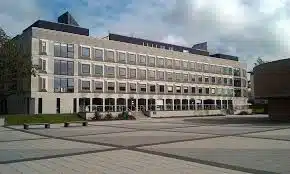
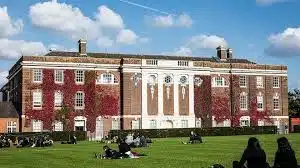
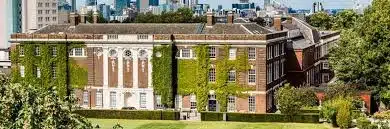
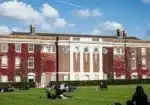
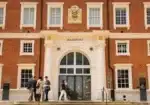
Goldsmiths began in 1792 as Counter Hill Academy in New Cross, a private boarding school for boys in a building constructed by Deptford distiller William Goodhew. In 1838, after the Academy closed, a new occupant took over in the shape of the Royal Naval school, who in turn built the present Richard Hoggart Building in 1843 to be a school for the sons of Royal Navy/Royal Marines Officers for the following half-century.
About Goldsmiths, University of London
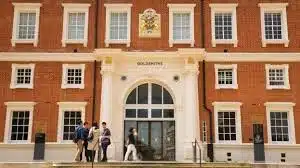
In 1889, the Royal Naval School vacated the premises, after which the Worshipful Company of Goldsmiths, recognized as a powerful Livery Company in the City of London, acquired the property. In the following year, the Livery Company established the “Technical and Recreative Institute of the Goldsmiths’ Company.” In the space of just more than a decade, the institute was a great success with more than 7,000 students enrolled from the predominantly male and female population of the “industrial and workmen’s quarter” of New Cross.
Goldsmiths, University of London – Table of Contents
- About
- Expansion and Academic Recognition
- Global Standing
- Development of Campus Spaces
- Development of Creative Talent
- Courses Offered
- Facilities And Infrastructure
- Required Documents
- Intake
- Eligibility Criteria
- Admission Process
- Other Courses
Shifts in Focus and Curriculum The Technical and Recreative Institute provided a broad selection of Arts and Sciences courses, many of which were available to lead to City and Guilds and similar qualifications. A School of Art was developed out of the Institute and continued to be well-funded even after the college was formed. The School of Art also changed its focus from craft instruction to fine art, which differentiated it from other London art schools.
During the student days of art, a large number of students did not take any examination or earn a qualification, but still, Goldsmiths had a good number of artists from the now-reputed ‘School of Goldsmiths’ Etchers and the well-known War Artist, Sutherland. After Goldsmiths began focusing more on art education, there has been a massive academic progression, incorporating Goldsmiths as part of the University of London in 1904.

Expansion and Academic Recognition
“By the early 1960s, Goldsmiths was firmly established in offerring respected diploma programs in painting, sculpture, and textiles. The Evening Department complemented this by offering a range of non-vocational courses, again in keeping with the inclusive ethos of the original Institute.”
The range of courses that had been made available in the past had been an indicator of the growth to come.
Over the course of the 1960s and the 1970s, Goldsmiths continued to develop its degree provision as student numbers grew. Over time, subjects initially established as part of the teacher training programs evolved into distinct degree programs.
By the early 1980s, the college provided not only undergraduate programs but also postgraduates in the arts and humanities. Enrollment had over double the student numbers. In the 1990s, Goldsmiths was granted full higher education status with official recognition. It is symbolized by a charter from Her Majesty the Queen.
Global Standing and Interdisciplinary Focus
Goldsmiths’ reputation for being at the global forefront was re-affirmed in 2019 by the QS rankings that placed the institution within the global top 100 for Arts and Humanities. In total, five of its subjects feature within the global top 50. Now Goldsmiths advocates for interdisciplinarity in its academics by encouraging its students to work together with academics from different departments within an environment that facilitates novel programs and ambitious work.
Development of Campus Spaces
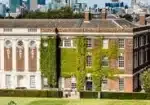
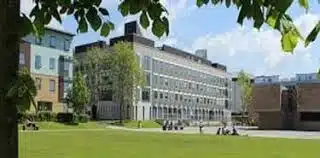
The design of the campus also varies due to the growth of the institution. The Richard Hoggart building, which began as a design by a Victorian architect, Robert Shaw, in 1843, still remains an important part of the Goldsmiths building. During the 1890s, the Goldsmiths company added a number of facilities, including a gymnasium, a concert hall, and a swimming pool. A new School of Art building was opened in 1907 to designs by Sir Richard Blomfield.
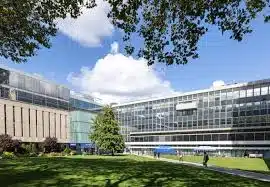
The Second World War saw severe bomb damage, including the loss of the library, roof, and swimming facilities. Teaching commenced again in 1946, and reconstruction of wartime bomb damage was largely complete by 1947. Modern Architectural Expansion During the late 20th and early 21st centuries, significant changes occurred on university campuses. The Rutherford Building was opened in 1998 and was recognized as one of London’s “Top 10” new buildings and was awarded the RIBA prize. In 2005, the Ben Pimlott Building was opened and houses various teaching rooms, art studios, and lecture rooms, among others.
The university continued to expand, adding the Professor Stuart Hall Building in 2010 for Media, Communications, and Cultural Studies and with this addition included teaching rooms, meeting spaces, a café, and a 250-seat lecture theatre. Finally, in 2018, the Goldsmiths Centre for Contemporary Art popped up in the restored Grade II-listed building of Laurie Grove Baths, hosting world-class exhibitions of contemporary art in the heart of South East London.
The Development of Creative Talent
Goldsmiths has long been known for spotting and supporting outstanding talent. Nine alumni and staff have won the Turner Prize, with another 24 shortlisted. Among them is Steve McQueen, who became the first Black director to win the Academy Award for Best Picture for 12 Years a Slave.
In literature, Bernardine Evaristo made history in 2019 as the first Black woman to win the Booker Prize for Girl, Woman, Other. Meanwhile, alumni have found success across music, film, and the arts, securing prizes including the Mercury Prize, BAFTA, and the Ivor Novello Award. The Goldsmiths Prize, launched in 2013, continues to reward innovation in fiction.
A Commitment to Community Goldsmiths has had community engagement embedded into its mission since its founding in 1891, where the Institute aimed to enhance skill, knowledge, health, and wellbeing for working-class communities. Early students enjoyed recreational activities, cultural societies, and a broad array of educational opportunities.
This ethos carried through to the Evening Institute, started in 1931 and expanding after World War II. Today, Goldsmiths remains actively involved in community initiatives across New Cross and South East London. More recent examples include a community mural to mark the 1977 Battle of Lewisham; leading Lewisham’s designation as a London Borough of Culture; and the creation in 2021 of London’s first Civic University Agreement, all underlining Goldsmiths’ enduring commitment to social responsibility.
Latest Notifications:
Courses Offered and Duration & Cost of Study in Goldsmiths, University of London
Computer Games: Art & Design
Course Details
Study Mode: Full Time / Part Time
- Duration: 1 year, tuition fee: 21,000 GBP, Course starts in September.
- Duration: 2 years of part-time, Course starts in September.
Entry Requirements
- An undergraduate degree of at least second-class standard in a relevant or related subject, such as Game Design/Development, Art, Design, 3D Modelling, Animation, or Computer Science.
- Applicants without a degree or with a degree in an unrelated discipline may also be considered if they have relevant professional experience and can demonstrate the ability to study at postgraduate level.
- If English is not a first language, an IELTS score of 6.5 overall (or equivalent) is required, with no individual component below 6.0.
Photography Practice
Course Details
Study Mode: Full Time
- Duration: 1 year, tuition fee: 27,500 GBP, Course starts in September.
Entry Requirements
- Applicants should have (or be expecting to be awarded) an undergraduate degree of at least second-class standard in a relevant or related subject, along with a level of practical experience in a relevant area.
- Applicants without a degree or with a degree in an unrelated discipline may also be considered if they have relevant experience and can demonstrate the ability to study at postgraduate level.
- Applicants are required to submit a photographic portfolio consisting of 10–20 images or relevant media.
- Applicants must also provide a five-minute video or screen recording in which applicants present and discuss their portfolio.
- If English is not a first language, an IELTS score of 6.5 overall (or equivalent) is required, with 6.5 in Speaking and no individual component below 6.0.
Sociology
Course Details
Study Mode: Full Time / Part Time
- Duration: 1 year, tuition fee: 23,000 GBP, Course starts in September.
- Duration: 2 years of part-time, Course starts in September.
Entry Requirements
- An undergraduate degree of at least second-class standard in a relevant or related subject.
- Applicants without a degree or with a degree in an unrelated field may be considered for some programmes if they have relevant experience and can demonstrate the ability to study at postgraduate level.
- If English is not a first language, an IELTS score of 6.5 overall (or equivalent) is required, with 6.5 in Writing and no individual component below 6.0.
Fine Art
Course Details
Study Mode: Full Time
- Duration: 2 years, tuition fee: 32,000 GBP, Course starts in September.
Entry Requirements
- Students must have (or be expecting to be awarded) an undergraduate degree of at least second-class standard (or an international equivalent), along with experience as an artist.
- To apply for direct entry into Year Two (full-time or part-time), students must already hold 120 graded credits from relevant postgraduate study.
- If English is not a first language, an IELTS score of 6.5 overall (or equivalent) is required, with 6.5 in Writing and no individual component below 6.0.
Computer Science
Course Details
Study Mode: Full Time
- Duration: 3 years, tuition fee: 32,000 GBP, Course starts in September.
Entry Requirements
- Applicants without a degree or with a degree in an unrelated field may be considered for some programmes if they have relevant experience and can demonstrate the ability to study at postgraduate level.
- If English is not a first language, an IELTS score of 7.0 overall (or equivalent) is required, with 7.0 in Writing and no individual component below 6.5.
Computer Games Programming
Course Details
Study Mode: Full Time
- Duration: 3 years, tuition fee: 22,000 GBP, Course starts in September.
Entry Requirements
- An undergraduate degree of at least second-class standard in a relevant or related subject, such as Game Design/Programming or Computer Science.
- Applicants without a degree or with a degree in an unrelated field may be considered for some programmes if they have relevant experience and can demonstrate the ability to study at postgraduate level.
- If English is not a first language, an IELTS score of 6.5 overall (or equivalent) is required, with no individual component below 6.0.
Data Science
Course Details
Study Mode: Full Time
- Duration: 3 years, tuition fee: 25,500 GBP, Course starts in September.
Entry Requirements
- A strong foundation in data science with specialist knowledge in a particular field.
- Prior programming experience is not required; however, applicants must demonstrate a good level of mathematical ability, typically gained through completion of a numerate degree.
- A BA or BSc degree with at least a 2:2 standard (or equivalent) in subjects such as Computer Science, Mathematics, Statistics, Engineering, or other quantitative disciplines like Economics or Finance.
- If English is not a first language, an IELTS score of 6.5 overall (or equivalent) is required, with no individual component below 6.0.
Data Science and Artificial Intelligence
Course Details
Study Mode: Full Time
- Duration: 3 years, tuition fee: 25,500 GBP, Course starts in September.
Entry Requirements
- Programme Focus: Foundation in Data Science and specialist knowledge in a particular field.
- Programming Experience: No prior programming experience is assumed.
- Mathematical Requirement: Requires mathematical dexterity equivalent to completing a numerate degree.
- BA or BSc degree at 2.2 standard or above.
- English Language Requirement (if applicable):
- IELTS score: 6.5 overall
- Minimum in each element: 6.0
MSc Forensic Psychology
Course Details
Study Mode: Full Time
- Duration: 1 year, tuition fee: 21,000 GBP, Course starts in September.
Entry Requirements
- Academic Qualification: Undergraduate degree of at least second-class standard in Psychology or a similar relevant subject.
- English Language Requirement (if applicable):
- IELTS score: 6.5 overall
- Writing: 6.5
- No element lower than: 6.0
Management of Innovation
Course Details
Study Mode: full time
- Duration: 1 year, tuition fee: 25,500 GBP, Course starts in September.
Entry Requirements
- Academic Qualification:
- An undergraduate degree of at least second-class standard in a relevant or related subject.
- Candidates with non-graduate status or a degree in an unrelated field may also be considered if they have relevant experience and the ability to work at postgraduate level.
- All aspects of the application are considered, and an offer may be made even if formal qualifications or grades do not meet the published requirements.
- IELTS score: 6.5 overall
- Writing: 6.5
- No element lower than: 6.0
Latest Updates:
Facilities And Infrastructure in Goldsmiths, University of London
Campus Overview
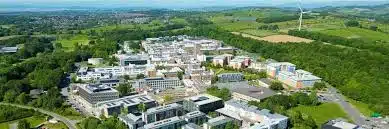
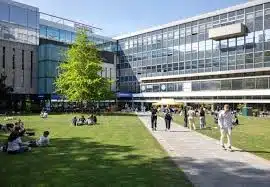
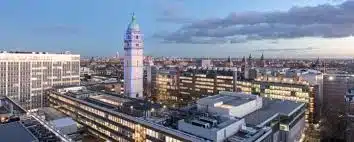
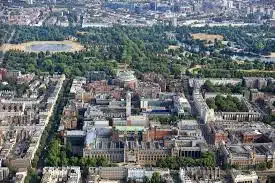
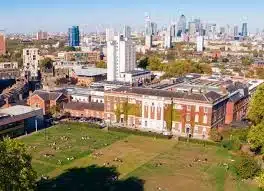
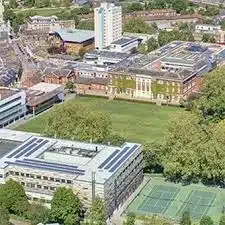
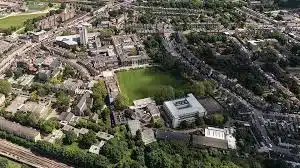
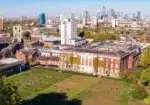
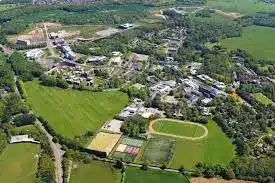
Goldsmiths is located on a single-site campus in New Cross, South East London, offering a compact but well-equipped environment that supports creative, academic, and social life.
Library & Study Spaces
- A modern Library open 24/7 throughout most of the academic year with extensive print and digital collections covering Arts, Humanities, and Social Sciences.
- Study areas for both individual and group work, laptop borrowing, and IT facilities available.
- Students also have access to broader University of London library resources at Senate House in Central London.
Academic & Specialist Facilities
Goldsmiths offers subject-specific facilities across many departments:
Art & Design
- Dedicated Art Practice Areas (APAs) with studios and workshops for 3D printing, ceramics, textiles, printmaking, metalwork, photography, and woodwork.
- Design workshops with fabrication and prototyping labs.
Media, Film & Communications
- TV and radio studios, darkrooms, production rooms, and digital editing suites.
Computing & Digital Labs
- Multiple computing labs across buildings with PCs and Macs, virtual reality labs, motion capture, UX labs, and HatchLabs.
Performance & Theatre
- A theatre, performance studios, scenography workshops, and tech support for theatre students.
Psychology & Social Sciences
- Lecture theatres, seminar rooms, and specialised teaching spaces in buildings such as Whitehead.
Eating & Social Spaces
- A range of cafés and food outlets including the campus refectory, pop-up food options, and cafés in key buildings.
- Social spaces for students to meet, dine, and relax.
Accommodation
Goldsmiths provides several accommodation options on and near campus, including halls and residences with en-suite rooms and communal spaces.
Sports & Recreation
- Outdoor spaces like tennis and netball courts and a large backfield for football and recreation.
- Sports and fitness facilities managed through the Students’ Union with various sports clubs and activities.
IT & Digital Support
- Wi-Fi access across campus and in accommodation, plus computing facilities, scanners, and multimedia equipment.
- IT support available for students struggling with access or technology issues.
Student Support
Goldsmiths also offers extensive student support services including academic help, careers advice, counselling, chaplaincy, and wellbeing support.
Required Documents For Admission in Goldsmiths, University of London
- Proof of Identity
- Valid passport (all students).
- UK/Irish nationals may alternatively present a driving license photocard or birth certificate (passport needed if license shows birth outside UK/Ireland).
- Original ID must be presented in person during enrolment.
- Evidence of Qualifications
- Original certificates, transcripts, or confirmation of awards (signed/stamped by the institution) if not already checked at application.
- All documents must be in English or accompanied by certified translations.
- Visa / Immigration Documents (for international students outside UK/Ireland)
- Valid student visa or other immigration permission covering the full course.
- Visa/immigration documents must be shown in person during enrolment.
- Proof of Fee Payment / Sponsorship
- Evidence that tuition fees are paid or have private sponsorship if applicable.
- Document Submission Process
- Applicants should upload digital copies of required documents via My Goldsmiths after completing online enrolment.
- Original physical documents must be shown in person to complete the registration.
Important Notes
- All documents must be in English — translations must be certified.
- Failure to provide required documents means may be unenrolled.
- The university may also request additional documents (e.g., proof of English language test, CAS for visa applications, etc.) as part of the offer process — check a specific offer email for details.
Intake For Goldsmiths, University of London
- Primary intake (Autumn/September): Most of the graduate Master’s programs start in September or October of a year. This intake is in effect from October of the preceding year.
- January/Spring Intake – A small number of courses are offered in January, and the new term begins in January.
- No fixed deadline: Generally, many postgraduate programs have “rolling admissions” and accept applications on a continuous basis.
Official site For Goldsmiths, University of London: Click Here
Eligibility Criteria For Admission in Goldsmiths, University of London
- Master’s Degrees, Postgraduate Diplomas & Certificates
- Students should normally have (or be expecting to be awarded) an undergraduate degree of at least second-class honours (2:2 or above) in a relevant subject.
- MRes (Research Master’s) Programmes
- Students should normally have (or expect to be awarded) an upper-second class honours degree (2:1 or equivalent) in a relevant area.
- MPhil/PhD Research Programmes
- Students should normally have (or expect to be awarded) a taught Master’s degree in a relevant subject area before entry.
- Programme-Specific Requirements
- Some courses may have additional academic requirements (e.g., portfolio, audition, interview, work experience or “fitness to train”). Check the course page for details.
- Unrelated Backgrounds Considered
- Applicants with degrees in unrelated subjects may still be considered subject to a qualifying assessment or interview. Relevant professional experience may also be considered.
English Language Requirement
- English Proficiency
- If English isn’t a first language, applicants must meet the university’s English language requirement (e.g., IELTS or equivalent).
- Acceptable Qualifications
- A range of English language qualifications are accepted — IELTS is preferred but other recognised tests may be used.
International Qualifications
- Global Qualification Recognition
- Goldsmiths accepts qualifications from many countries; if you’re unsure whether an applicant is eligible, contact the Admissions Office for verification.
Other Considerations
- Application Requirements
- Check if a specific programme requires a personal statement, references, research proposal (for research degrees), portfolio, or interview as part of an eligibility.
Important Notes
- Academic entry requirements and English language conditions are programme specific — always refer to the individual course page for exact details.
- Meeting minimum requirements does not guarantee admission; selection is competitive and based on overall application strength.
Get more details about the colleges in Kyrgyzstan: Click Here
Admission Process for Master’s Degrees in Goldsmiths, University of London
- Find the Programme
- Goldsmiths’ website and choose the Master’s programme applicant you want to apply to. Each course page shows specific entry requirements and any programme-specific instructions.
- Check Entry Requirements
- Make sure to meet the academic qualifications, English language requirements, and any additional criteria (e.g., portfolio, interview, work samples) listed on the programme page.
- Start an Application Online
- Click “Apply Now” on the course page to begin an application through the My Goldsmiths online application system.
- Exceptions: Some programmes like MA in Social Work or PGCE courses have different application routes (e.g., through UCAS), but most Master’s applications go through My Goldsmiths.
- Prepare Supporting Documents
- Upload required documents such as academic transcripts, references, personal statement, and portfolio/samples if requested.
- Ensure the documents are clear, complete, and where necessary, translated into English.
- Write a Personal Statement
- This is a key part of the application where you can explain student motivation, suitability, and reasons for choosing the programme.
- Submit Work Samples / Portfolio (if required)
- Some creative or specialised Master’s courses may ask for work examples, portfolios, or explicit evidence of skills. Follow instructions given on the specific programme page.
- Application Review
- After submission, the academic admissions team reviews on application and documents.
- Interview (if applicable)
- For some programmes, applicants may be invited to an interview, either in person or online.
- Decision Notification
- Applicants will receive a conditional or unconditional offer or a rejection. Conditional offers must meet certain requirements before enrolment, such as final grades or language scores.
- Accept Offer
- Accept the offer through a university account.
- Meet Any Conditions
- Complete conditions (e.g., final degree results, English language proof, fitness to train forms if required) before the deadline specified in offer letter.
- Prepare for Arrival
- Once conditions are met and an offer is accepted, prepare for enrolment, visa (if applicable), accommodation, and arrival logistics.
Additional Notes
- Application timing: Applications usually open in October for entry the following September, and there is no formal deadline for most taught Master’s unless specified on the specific programme page.
- International students: Ensure to understand the visa process and provide all necessary immigration documents after receiving an offer. (Separate guidance is available on the university’s international pages.)
List of Other Courses in Goldsmiths, University of London
- Foundation in Art and Psychodynamic Thinking
- Foundation in Dance Movement Psychotherapy
- Humanistic & Psychodynamic Counselling
- Contemporary Art History
- LLM Criminal Justice
- LLM Criminal Justice & Human Rights
- LLM Law
- MA Literary Studies
- MA Media and Communications
Also Check:
Gallery


Map View
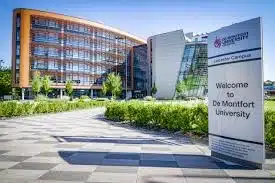
De Montfort University Leicester
De Montfort University Leicester Rich historical setting of the campus and
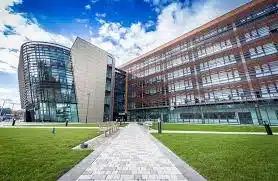

Lancaster University
Lancaster University Founding and Historical Background The origins of Lancaster University