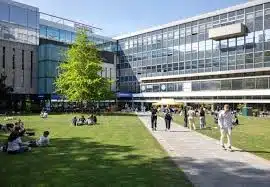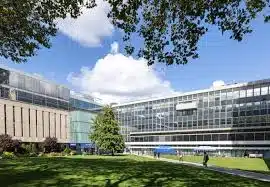
Leeds Trinity University and All Saints College were two distinct colleges in 1966. The administrative tasks were shared, with the Sisters of the Cross and Passion administering the women’s college and the Catholic Education Council administering the men’s college. Sister Augusta Maria was appointed as the Principal of Trinity College, and Andrew Kean was appointed as the Principal of All Saints College.
About Leeds Trinity University
Even though they had different positions, they collaborated with each other and eventually shared the responsibilities of overall administration. Andrew Kean looked after the development of the curriculum, academic staff, and external affairs, whereas Sister Augusta Maria handled pastoral care, finances, buildings, social events, and non-academic staff. Their memory lives on in the form of the Sister Augusta Maria C.P. Auditorium and the Andrew Kean Learning Centre at the Horsforth campus.
Leeds Trinity University – Table of Contents
- About
- Accreditations, Affiliations, Recognitions
- Ranking
- Courses Offered
- Facilities And Infrastructure
- Required Documents
- Eligibility Criteria
- Admission Process
- Other Courses
In the 1960s, the increasing need for qualified teachers led to the adoption of an innovative approach to teacher education by the colleges. Unlike traditional institutions for teacher training, the colleges strongly emphasized school-based experience, which still influences teaching and learning at the institution. By the mid-1970s, the curriculum had broadened considerably, with 16 courses offered through six academic departments.
The colleges also led the way in integrating work placements into degree courses. Based on the success of the placement model in teacher training, work placements were introduced into subjects such as Communication Arts, English, History, Modern Languages, and a number of other disciplines.

Leeds Trinity University Accreditations, Affiliations, Recognitions
In 1980, Trinity College and All Saints College merged to form Trinity and All Saints College (TASC). Dr Mary Hallaway became the principal, and her legacy lives on in the form of the Mary Hallaway Lecture Theatre and her role as an Honorary Fellow of the University.
However, by the mid-1980s, the role of the Sisters of the Cross and Passion had diminished, and the College began to recruit in a more inclusive manner. The College made it clear that it was not exclusively for Catholics and that the College community should reflect the multicultural and multi-faith society that exists a philosophy that remains at the heart of the College to this day.
In 1989, Dr Gerard Turnbull took over the reins of the College. During his tenure, the number of students increased substantially, with more than 2,000 undergraduates and 250 postgraduates by the time he retired in 1998. He introduced new academic courses and developed the campus infrastructure, which included the opening of Kirkstall Halls in 1993, offering part-catered accommodation.
It was during this time that the College gained a reputation as a leader in Communications and Media and, in 1994, opened the Leeds Centre for Victorian Studies, which continues to be part of the University to this day. After Dr Turnbull’s retirement, Dr Mike Coughlin became the Principal of the College and led the College’s drive to gain taught degree awarding powers and become a University College.
However, by the early 2000s, the number of students had risen to 3,000, and the college was one of the first to offer innovative courses such as Forensic Psychology and Sports Journalism. The Centre for Journalism was founded in 2001, and the Andrew Kean Learning Centre was opened in 2003.
Major developments emerged in the area of student representation and facilities. In 2005, changes to the Students’ Union brought about the establishment of a Student Council and Executive Committee, as well as the election of new positions such as Mature Students’ and LGBT Officers. With the appointment of Professor Freda Bridge in 2006, more investment followed, and a new £2.2 million sports center was opened in 2007. In 2009, the College gained taught degree awarding powers and became Leeds Trinity University College.
With the new status of University College, the institution began to target full university status. In 2011, the government policy changed, and the minimum student requirement for university status was lowered. In 2012, Leeds Trinity University College received full university status and was renamed Leeds Trinity University.
Professor Margaret House OBE was appointed as the Vice-Chancellor in July 2012, and in 2013, Leeds-born broadcaster Gabby Logan became the Chancellor. This was a time of great investment, including new halls of residence, improved sports facilities, improved Students’ Union facilities, the establishment of Leeds Children’s University, and the establishment of international links. Research output also grew, with more funding and additional Professors.
Latest Notifications:
Leeds Trinity University Ranking
In 2016, Leeds Trinity University celebrated its 50th anniversary with a series of events taking place throughout the year. These included events at the Houses of Parliament, Westminster Cathedral, and around the city of Leeds, as well as a Gala Dinner. The University also launched the Trinity Talks public lecture series and the Inspiring Futures Programme.
However, further growth came with the launch of Degree Apprenticeships, Higher Apprenticeships, and Foundation Year courses. The University received a silver award in the Teaching Excellence Framework in 2017, while its business and education networks expanded further. International placements and volunteering activities also became more popular among the students.
In 2018, Gabby Logan resigned as Chancellor after five years of service, and actor and playwright Deborah McAndrew was appointed as her replacement.
Looking ahead, Leeds Trinity University is committed to providing academic excellence, improving the employability of its graduates, and developing future researchers with the ultimate aim of gaining Research Degree Awarding Powers. In November 2020, Professor Charles Egbu took over as the Vice-Chancellor of the University, succeeding Professor Margaret House OBE, and the University continues to maintain its Catholic tradition while promoting an open, inclusive, and welcoming environment.
Latest Updates:
Courses Offered and Duration & Cost of Study in Leeds Trinity University
Business Administration MBA
Course Details
Study Mode: Full Time/Part Time
- Duration: Full Time 1 year Course starts in January and September.
- Duration: Part Time 2 years Course starts in January and September.
Entry Requirements
- Applicants must hold an Honours degree with a minimum classification of 2:2.
- Alternatively, applicants without a degree are considered if they can demonstrate equivalent work-based experience or a relevant Continuing Professional Development (CPD) portfolio.
- Applicants applying through the work-based experience route must provide:
- A detailed employer reference outlining their role and responsibilities within their professional setting.
- A comprehensive CV demonstrating relevant expertise in education and/or Special Educational Needs and Disabilities (SEND).
- A personal statement or letter of support explaining how their professional experience enables them to successfully access and complete the course.
- A letter of support from their workplace confirming agreement to support the required work-based portfolio activities.
Business Analytics MSc
Course Details
Study Mode: Full Time/Part Time
- Duration: Full Time 1 year and 16 months Course starts in January and September.
- Duration: Part Time 2 years Course starts in January and September.
Entry Requirements
- Applicants must hold an honours degree (2:2 or above) in any discipline, with particular encouragement for those from business, computer science, psychology, or sociology backgrounds.
- Candidates without a degree and also be considered if they have at least three years of relevant work experience at management level.
- Applicants are eligible through the successful completion of a pre-master’s programme from an institution acceptable to the University, assessed on a case-by-case basis.
- Sponsored students must meet the English language requirement of IELTS Academic 6.0 overall, with no component below 5.5, or an equivalent qualification.
Business Studies PGCE
Course Details
Study Mode: Full Time/Part Time
- Duration: Full Time 1 year Course starts in September.
Entry Requirements
- Applicants must hold a good honours degree (normally 2:2 or above) with a significant Business component; candidates with third-class honours are considered individually if they have additional qualifications and/or substantial relevant professional experience.
- A GCSE Grade 4 (C) or above, or an accepted equivalent, is required in English Language or English Literature and Mathematics; applicants without proof or the required grades should refer to the GCSE Equivalency guidelines.
- Applicants must demonstrate the ability to read effectively and communicate clearly and accurately in spoken and written standard English.
- The minimum English language requirement is IELTS Academic 6.0 overall, with no component below 5.5, or an equivalent qualification.
- International applicants whose first language is not English must provide acceptable evidence of English language proficiency as part of their application, in line with UKVI-approved qualifications and exemption rules.
Computer Science MSc
Course Details
Study Mode: Full Time/Part Time
- Duration: Full Time 1 year and 16 months Course starts in January and September.
- Duration: Part Time 2 years Course starts in January and September.
Entry Requirements
- Applicants must hold an honours degree (2:2 or above) in a STEM or Computing-related subject; OR
- An honours degree (2:2 or above) in an unrelated subject, supported by previous employment or substantial industry work experience (applicants need required to discuss their experience with the Programme Leader).
- A non-honours bachelor’s degree studied for three years in a STEM or Computing-related subject, plus at least one year of relevant professional industry experience.
- Successful completion of a pre-master’s programme from an institution acceptable to the University, assessed on a case-by-case basis.
- Academic requirement: Bachelor’s degree studied for a minimum of three years at a recognized university, with a minimum overall grade of 55%.
- English language requirement: IELTS Academic 6.0 overall, with no component below 5.5, or an equivalent qualification.
Computer Science with ICT PGCE
Course Details
Study Mode: Full Time
- Duration: Full Time Course starts in September.
Entry Requirements
- A good honours degree (normally 2:2 or above) with a significant Computer Science component is required; applicants with third-class honours are considered individually if they have additional qualifications and/or substantial relevant professional experience.
- Applicants must hold GCSE Grade 4 (C) or an accepted equivalent in English Language or English Literature and Mathematics, or meet the GCSE Equivalency requirements if evidence is unavailable.
- Candidates must demonstrate the ability to read effectively and communicate clearly and accurately in spoken and written standard English.
- Applicants must possess appropriate personal and intellectual qualities for teaching in secondary schools, including suitable professional values and attitudes.
- Applicants should show commitment and potential to train as a secondary teacher; while experience in secondary schools is desirable, it is not mandatory.
- Applicants requiring student visa sponsorship must meet the English language requirements, with a minimum of IELTS Academic 6.0 overall and no component below 5.5, or an equivalent qualification.
Data Science and Artificial Intelligence MSc
Course Details
Study Mode: Full Time/Part Time
- Duration: Full Time 1 year and 16 months Course starts in January and September.
- Duration: Part Time 2 years Course starts in January and September.
Entry Requirements
- The MSc programme is open to applicants from all academic backgrounds, not limited to Computer Science graduates, and values diverse skills and perspectives.
- Applicants hold an honours degree (minimum 2:2) in a computing-related subject, OR have equivalent professional experience in the field, OR possess a non-STEM degree and wish to transition into the discipline.
- The University recognizes that academic qualifications alone do not define potential and provides supportive pathways for applicants from varied backgrounds.
- International applicants whose first language is not English must submit evidence of English language proficiency as part of the application process.
Digital Marketing MSc
Course Details
Study Mode: Full Time/Part Time
- Duration: Full Time 1 year and 16 months Course starts in January and September.
- Duration: Part Time 2 years Course starts in January and September.
Entry Requirements
- An honours degree (2:2 or above) in any discipline.
- Alternatively, applicants without a degree but with subsequent work-related experience (at least three years at management level) will be considered.
Financial Technology MSc
Course Details
Study Mode: Full Time/Part Time
- Duration: Full Time 1 year and 16 months Course starts in January and September.
- Duration: Part Time 2 years Course starts in January and September.
Entry Requirements
- Applicants must hold an honours degree (minimum 2:2) in any discipline.
- Applicants with significant professional or business experience (at least three years at management level) are considered subject to a short interview.
- The programme welcomes applicants from both finance and non-finance backgrounds.
- International applicants whose first language is not English must provide evidence of English language proficiency as part of the application process.
Forensic Psychology MSc
Course Details
Study Mode: Full Time/Part Time
- Duration: Full Time 1 year Course starts in September.
- Duration: Part Time 2 years Course starts in September.
Entry Requirements
- Applicants must hold an Honours degree (minimum 2:1) in Psychology or an equivalent qualification (such as an MSc Psychology Conversion) that confers Graduate Basis for Chartered Membership (GBC) with the British Psychological Society (BPS).
- Applicants are strongly encouraged to have relevant voluntary or paid experience in forensic contexts, such as working with offenders, individuals at risk of offending, victims, or through observation of criminal court proceedings.
- Applicants who meet the entry requirements will be invited to an interview as part of the admission process.
- During the interview, applicants asked about their interest in Forensic Psychology, understanding of the course, research interests, relevant experience or future plans, and what they hope to gain from the programme.
- The interview provides an opportunity for the University to assess the applicant’s suitability and understanding, while also allowing the applicant to learn more about the course.
Forensic Psychology Practitioner PG Dip
Course Details
Study Mode: Part Time
- Duration: Part Time 2 years Course starts in September.
Entry Requirements
- Applicants must hold a BPS-accredited undergraduate degree in Psychology.
- Applicants must also have a BPS-accredited Master’s degree in Forensic Psychology (or an equivalent Stage 1 qualification).
- Applicants who meet the academic entry requirements will be invited to attend an interview.
- Attendance at an interview is mandatory before an offer of a place on the course can be made.
International Business MA
Course Details
Study Mode: Full Time/Part Time
- Duration: Full Time 1 year and 16 months Course starts in January and September.
- Duration: Part Time 2 years Course starts in January and September.
Entry Requirements
- Applicants must hold an honours degree (2:2 or above) in any discipline.
- Applicants without a degree will be considered if they have significant professional or business experience, with a minimum of six years at management level.
- International applicants whose first language is not English must provide evidence of English language proficiency as part of the application process.
Journalism MA
Course Details
Study Mode: Full Time
- Duration: Full Time 1 year Course starts in September.
Entry Requirements
- Applicants must hold a good honours degree in a relevant subject (normally 2:2 or above) or demonstrate relevant industry experience.
- Shortlisted applicants will be invited to attend an interview to discuss their interest in the course and journalism more broadly.
Project Management MSc
Course Details
Study Mode: Full Time/Part Time
- Duration: Full Time 1 year and 16 months Course starts in January and September.
- Duration: Part Time 2 years Course starts in January and September.
Entry Requirements
- Applicants must hold an honours degree (2:2 or above) in any discipline.
- The bachelor’s degree must be studied for a minimum of three years at a recognized university, with a minimum overall grade of 55%.
- International applicants whose first language is not English must provide evidence of English language proficiency as part of their application.
Psychology (Conversion) MSc
Course Details
Study Mode: Full Time/Part Time
- Duration: Full Time 1 year Course starts in September
- Duration: Part Time 2 years Course starts in September.
Entry Requirements
- Applicants must hold a bachelor’s degree studied for a minimum of three years at a recognized university, with a minimum overall grade of 55%.
- International applicants whose first language is not English must provide evidence of English language proficiency as part of their application.
Facilities And Infrastructure in Leeds Trinity University
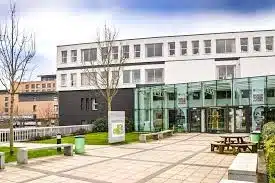
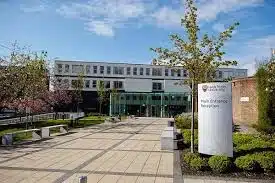
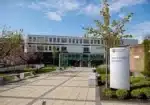
- Leeds Trinity University offers a contemporary and well-equipped campus environment that is designed to facilitate postgraduate education.
- The University provides advanced learning environments, such as well-equipped lecture theaters, seminar rooms, and collaborative study spaces that facilitate interactive and research-led learning for master’s programs.
- The Andrew Kean Learning Centre (Library) is an academic hub that offers a wide range of access to academic books, journals, e-books, and databases. The library has quiet study areas, group study rooms, IT facilities, and extended opening hours to facilitate postgraduate research.
- For subject-related learning, the University offers specialist facilities such as media production studios, journalism newsrooms, sports science laboratories, psychology suites, and performance spaces, depending on the chosen master’s programme.
- The campus has modern information technology infrastructure such as high-speed Wi-Fi connectivity, computer labs, specialized software, and online learning platforms that facilitate online learning for postgraduate students.
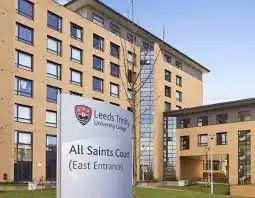
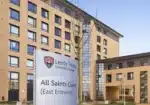
- Leeds Trinity University provides on-campus and off-campus accommodation options, such as All Saints’ Court and Fountains Court, which provide safe and comfortable environments suitable for postgraduate students.
- The University provides sports and fitness facilities, such as a sports center, gym, fitness rooms, outdoor pitches, and a 3G Astroturf pitch.
- Postgraduate students are provided with career and employability services, such as professional development workshops, placement, employer engagement, and use of the Leeds Trinity Business Network.
- The campus also offers student support services such as academic skills support, wellbeing and counseling services, chaplaincy, disability support, and postgraduate support.
- Based in Leeds, a large student city in the UK, the University has the advantage of transport connectivity, industry partnerships, cultural facilities, and career opportunities.
Official site For Leeds Trinity University: Click Here
Required Documents For Admission in Leeds Trinity University
Academic Qualifications
- Bachelor’s degree certificate from a recognised university (equivalent to UK standards).
- Academic transcripts detailing the subjects and grades.
- If applicant have not yet graduated, provide interim/partial transcript.
- If qualifications are not in English, include certified English translations of all certificates.
Proof of English Language Proficiency
- IELTS, TOEFL, PTE or an equivalent English language test result that meets the University’s requirement (this varies by programme; check specific course page).
- If Student studied previous degree fully in English, applicants are be eligible to submit a letter from university confirming the medium of instruction was English (check with Admissions).
Personal Statement / Statement of Purpose
- A written statement explaining the reasons for applying, academic interests, and career goals (required for many courses; especially taught MSc/MA programmes).
References
- Academic and/or professional referees who can comment on suitability for postgraduate study.
- Normally 1–2 references are requested, depending on the programme and its level.
CV / Resume
- An up-to-date CV detailing the educational history, work experience, and any relevant achievements.
Passport & Visa Documentation
For international students:
- A clear scan of the passport personal information page.
- Copies of any previous UK visas or visa refusals (if applicable).
- Some applicants also need to provide CAS-related documents once an offer is made.
Course-Specific or Additional Requirements
Some programmes require extra materials, for example:
- Portfolio of work (for creative or design-related Master’s courses).
- Research proposal (for research degrees like MPhil/PhD or Master’s by Research).
Before Submit
- Ensure all documents are in English or professionally translated.
- Keep both scanned copies (for upload) and original documents ready in case they are requested later.
- Check specific Master’s programme page on the University website for any additional requirements.
Eligibility Criteria For Admission in Leeds Trinity University
Academic Qualifications
- Applicants are normally expected to have a good honours bachelor’s degree or equivalent.
- Typically, this means a 2:2 (Second Class Honours) degree or above from a recognized institution.
English Language Proficiency
As part of the admission requirements, international applicants whose first language is not English must demonstrate adequate English language ability to succeed in postgraduate study. Accepted evidence includes recognized tests such as:
- IELTS Academic (commonly accepted minimum: 6.0 overall with no component below 5.5 for many courses).
- Pearson PTE Academic (minimum overall score usually around 59–75 depending on the programme).
- GCSE or IGCSE English (often accepted where applicable and taken under specific conditions).
Get more details about the colleges in Kyrgyzstan: Click Here
Admission Process For Leeds Trinity University
Choose the Course
Start by exploring the postgraduate programmes offered on the University’s website.
Carefully check entry requirements, course content, fees, and start dates before applying.
Submit student Application
There are two main application routes depending on applicant status:
Taught Master’s Degrees (MSc, MA, MBA, etc.)
- Apply directly to Leeds Trinity University using the online application form provided on the postgraduate application pages.
- Select the correct form for home applicants (UK/EU/EEA with settled status) or international applicants (requiring a UK visa).
- Complete all sections of the form and attach all required documents.
Research-based Master’s (e.g., MRes or Masters by Research)
- Prior to applying, I usually need to identify and contact a potential supervisor in the research area.
- Applicants also need to prepare a research proposal and arrange referees.
- Submit the application through the research application process.
Application Acknowledgement
Once a student application is received, the Admissions team will send a confirmation email.
If references are pending, the University waits for them before progressing the application.
Application Review
- The application is forwarded to the relevant Programme Leader or academic team.
- Decisions are made directly based on student documents,
- Applicants are invited to an interview or discussion (especially for research-focused or competitive programmes).
Receive an Offer
- If successful submission applicant receives either:
- A conditional offer (Applicant must meet certain academic or English language requirements before enrolment), OR an unconditional offer (no further requirements).
Offers are usually sent by email.
Accept the Offer
Once applicant receive an offer letter, applicant need to:
- Accept or decline the offer (often via email or the applicant portal).
- Provide supporting documentation to prove meet any conditions, by the deadline given.
- For international students requiring a visa, the University ask for further documents to issue a CAS (Confirmation of Acceptance for Studies).
Once all conditions are met and documents are verified:
- Confirming receive confirmation to register for a course.
- Applicant also be given information about orientation, module selection, and enrolment.
Other Courses in Leeds Trinity University
- Creative Writing MA
- Family Support MA
- Health and Wellbeing MSc
- Health and Wellbeing in the Workplace PG Cert
- Inclusive Leadership PG Cert
- Mental Health in Children and Young People MA
- Modern Foreign Languages PGCE
- Primary (3-7) PGCE
- Primary (5-11) PGCE
- Religious Education PGCE
- Law LLM
- Science with Biology PGCE
- Science with Chemistry PGCE
- Science with Physics PGCE
- Social Work MA
- Teaching English to Speakers of Other Languages (TESOL) MA
- Legal Practice LLM (Subject to final approval)
- Mathematics PGCE
- Nursing (Dual Award Adult and Mental Health Nursing) MNurs
- Geography PGCE
- History PGCE
- Construction Project Management MSc
- Criminology and Criminal Justice MA
- English PGCE
Also Check:
Gallery





Map View
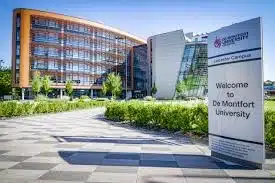
De Montfort University Leicester
De Montfort University Leicester Rich historical setting of the campus and



Lancaster University
Lancaster University Founding and Historical Background The origins of Lancaster University